Overview
Load Balancer is a service that distributes traffic to container instances. By using load balancing, traffic to workloads is automatically distributed and forwarded to container instances. Load balancing improves the fault tolerance of workloads, scales the external service capabilities of workloads, and enhances the availability of applications.
Host Network Mode
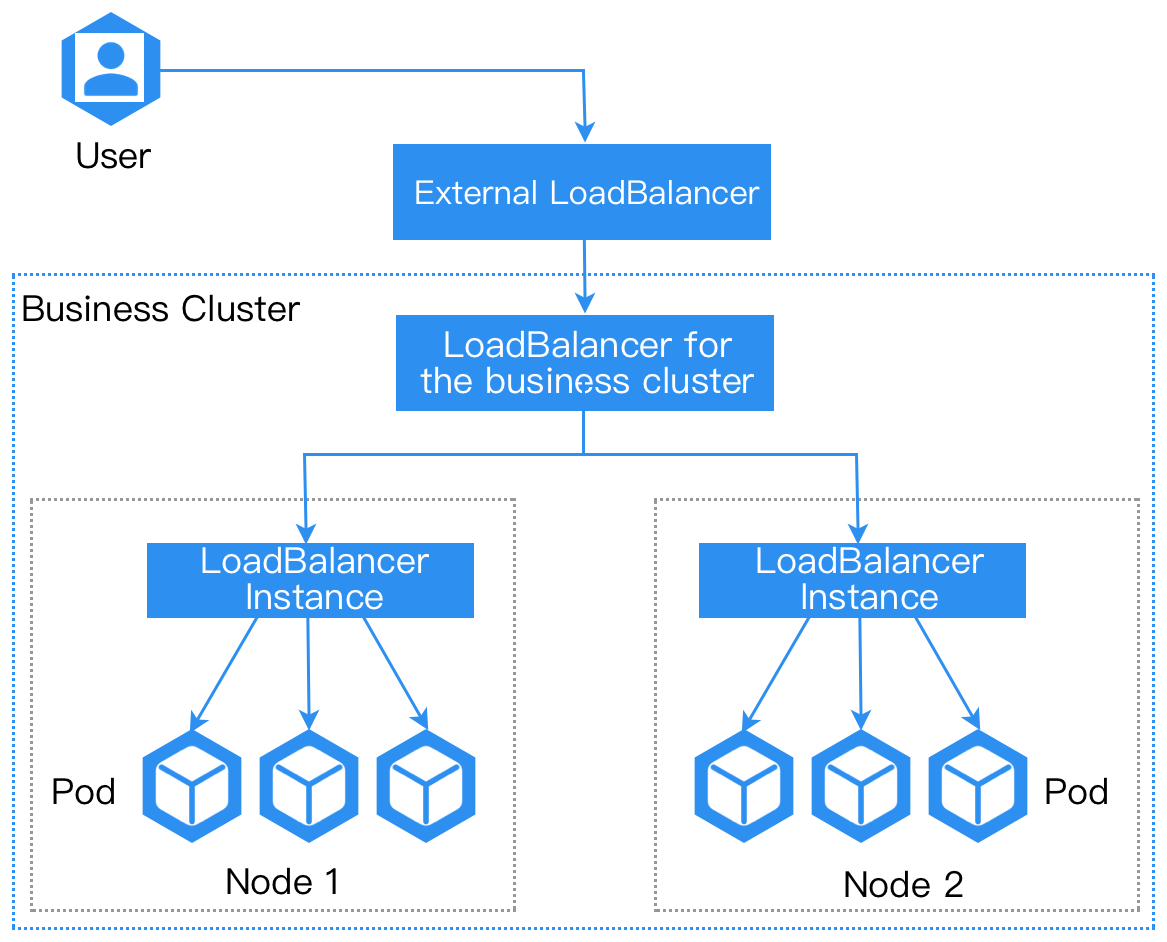
Allow the load balancer instance to directly reuse the network stack of the node, sharing the IP address and port with the node. In this mode, the load balancer instance directly binds to the node’s port, without the need for port mapping and encapsulation conversion similar to container networking, thus achieving optimal network performance.
Note: To avoid port conflicts, only one load balancer instance is allowed to be deployed on a single node.
Description
-
The load balancer instance by default listens on the addresses of all network cards on the node, and can be accessed by accessing any of the network card addresses.
-
When creating a load balancer, the access address is the VIP address outside the cluster. The running of the load balancer instance does not depend on this address. The purpose of this address is as follows.
-
When creating a native application, combine this access address to generate the access address for the application details page.
-
After creating the inbound rule, the IP address of the
ingressfield in the generated YAML file is generated.
-
Container Network Mode
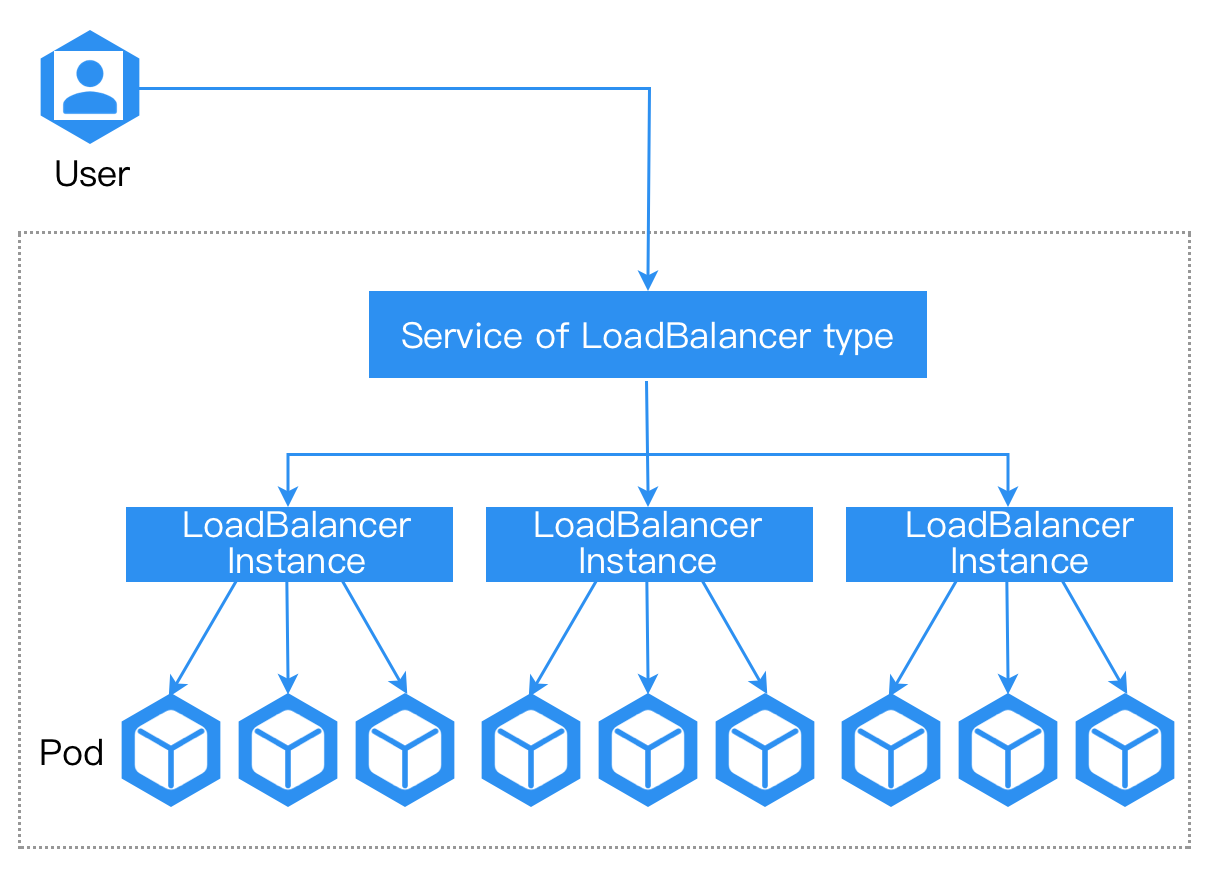
Container network type load balancer routes traffic from outside the cluster to load balancer instances through internal routing of LoadBalancer type, enabling business communication. Compared to host network mode, container network mode has slightly lower performance but supports deployment of more load balancer instances on nodes.
Ingress Sync Rule
-
When the inbound rules (Ingress) do not specify an inbound rule class (IngressClass), or the specified inbound rule class (IngressClass) is generated by the load balancer.
-
Load balancers created using the port resource allocation method will automatically resolve inbound rules (Ingress) only if the namespace has permissions for its 80 and 443 ports and if HTTP 80 and HTTPS 443 ports are created.
-
When a load balancer is created using the Instance resource allocation mode, the inbound rules (Ingress) within the namespace will be automatically resolved if the namespace has load balancer permissions.
Note: To ensure that inbound rules (Ingress) within a namespace can take effect when using only the platform load balancer, please make sure that the namespace has a load balancer that can resolve inbound rules (Ingress).
-
-
When the inbound rules (Ingress) specify an inbound rule class (IngressClass) that is not generated by a load balancer.
The platform load balancer no longer resolves inbound rules (Ingress). You need to ensure that the specified IngressClass has a controller that can be used to resolve inbound rules (Ingress).