Reports
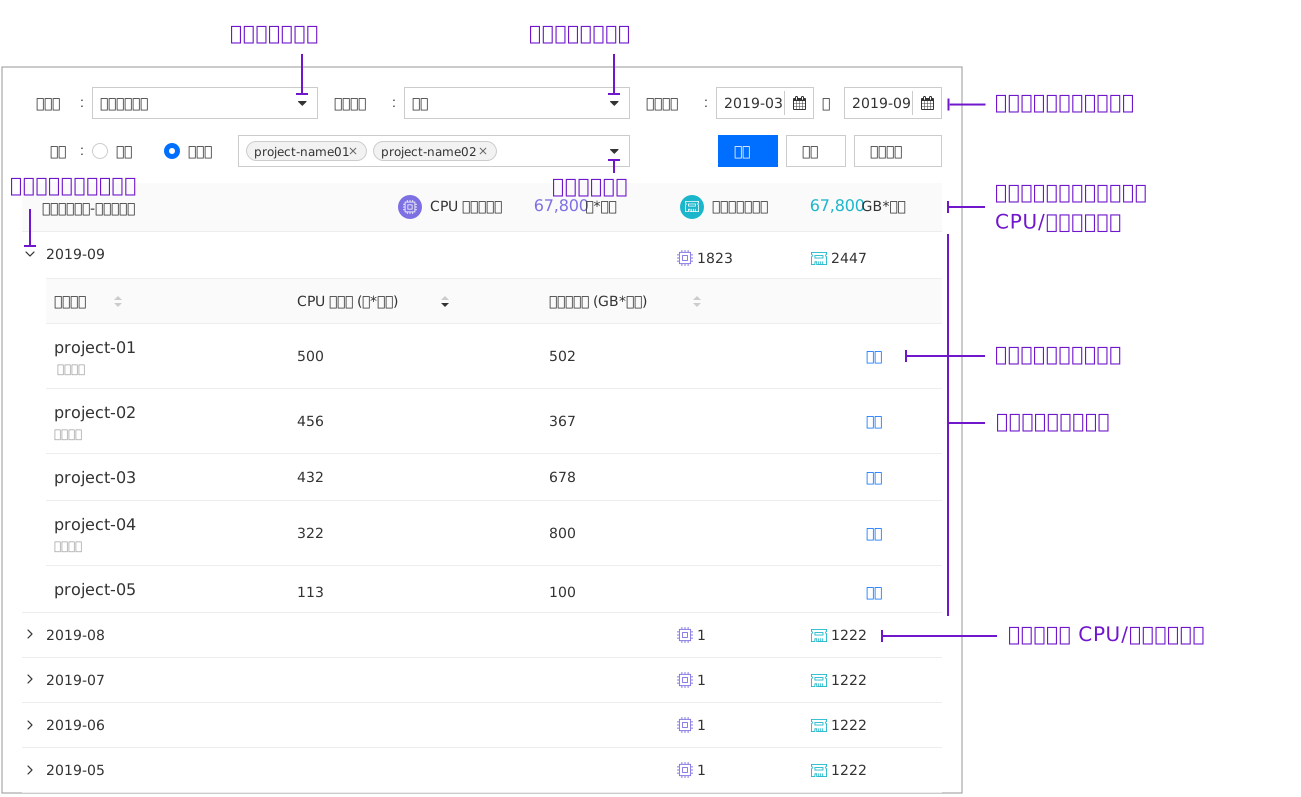
Operational statistics data can be retained on the platform for up to 540 days, and the platform will automatically delete statistics data that exceeds the retention time. It supports viewing visualized report data of statistics items within a custom time range (up to 6 months). Filtering can be done based on the statistical granularity (project, namespace) and projects (all, custom projects).
The statistics include: Pods usage, Pods quota, project quota, and namespace quota. Click Export Results to export the filtered statistical data as a CSV format report.
Note: Detailed data can only be viewed when the metric is “Pods Quota” or “Pods Usage”.
Procedure of operation
-
In the left navigation pane, click Metering > Reports.
-
Refer to the instructions in the following figure, select the statistical time range, statistical items, and statistical granularity. After configuring the project filtering conditions, click the Search button to view the corresponding statistical report data.
Note:
-
This document provides an overview of the Kubernetes infrastructure and the cloud-native industry.
-
Kubernetes is an open-source container orchestration platform that automates the deployment, scaling, and management of containerized applications.
-
The cloud-native industry refers to the use of containerization, microservices, and other cloud-native technologies to build and deploy applications in a scalable and resilient manner.
-
Kubernetes provides a set of abstractions and APIs that allow developers to define and manage the desired state of their applications, while the platform takes care of the underlying infrastructure and ensures high availability and fault tolerance.
-
The key components of a Kubernetes cluster include the master node, which manages the cluster and schedules workloads, and the worker nodes, which run the actual application containers.
-
Kubernetes uses a declarative approach to application management, where developers define the desired state of their applications in YAML or JSON files, and Kubernetes ensures that the actual state matches the desired state.
-
Kubernetes provides a rich set of features for managing containerized applications, including automatic scaling, rolling updates, service discovery, and load balancing.
-
The cloud-native industry is driven by the need for agility, scalability, and resilience in modern application development and deployment. It enables organizations to build and deploy applications faster and more efficiently, while also reducing costs and improving resource utilization.
-
In addition to Kubernetes, there are other cloud-native technologies and frameworks, such as Docker, Istio, and Prometheus, that provide additional capabilities for building and managing cloud-native applications.
-
The adoption of Kubernetes and other cloud-native technologies is growing rapidly, as more organizations recognize the benefits of a cloud-native approach to application development and deployment.
-
The platform retains data within 540 days and supports a maximum time range of 6 months for a single query.
-
Pod Usage: The total sum calculated by taking the average of the actual usage of Pods every 5 minutes.
-
Pod Quota: Counted based on the size of the Pod’s request value.
-
Namespace Quota: The CPU and memory quotas for each namespace are calculated and recorded once a day. The quota calculation is based on the quotas set for the namespace, and any changes to the quotas will be reflected in the calculation starting from the next day.
-
Project Quota: The project CPU and memory quotas are calculated once a day based on the project’s quota. After a quota change, the new quota will be calculated starting from the next day.
-
When the statistical item is
Pods quotaorPods usage, detailed information can be viewed. -
Support sorting by namespace name (first letter), project owner (first letter of name), total CPU usage (size), and total memory usage (size).
-