Access GKE Cluster
The platform supports connecting to GKE clusters.
Prerequisites
-
The satisfaction of Kubernetes version and components on the cluster Access to public cloud cluster version requirements .
-
Make sure the cluster type is a standard cluster and the account has the permission to maintain the control panel. Connecting to autopilot type clusters is not supported at the moment.
-
The repository must support HTTPS access and provide a valid TLS certificate authenticated by a public certificate authority.
Prepare Operation Environment
To comply with GKE security requirements, the following steps need to be performed using Cloud Shell.
-
Ensure connectivity with Google’s network.
-
Access the Cluster of clusters options page for Kubernetes Engine functionality; find the cluster to be connected, click on the cluster details, and select the Connect button.
-
In the pop-up dialog box, copy the command for configuring kubectl command line access permissions and click the Run in Cloud Shell button.
-
After Cloud Shell is ready, clear the command line, paste the content copied in the previous step, and execute it.
-
The environment is now ready. In the following steps, such as “Get cluster information” and “Cluster access”, the commands executed for accessing the cluster environment should be executed in Cloud Shell.
Get cluster information
Get Access Cluster apiserver Address and CA Certificate
-
Access the Cluster of clusters options page for Kubernetes Engine functionality, and click on the details page of the cluster to be connected.
-
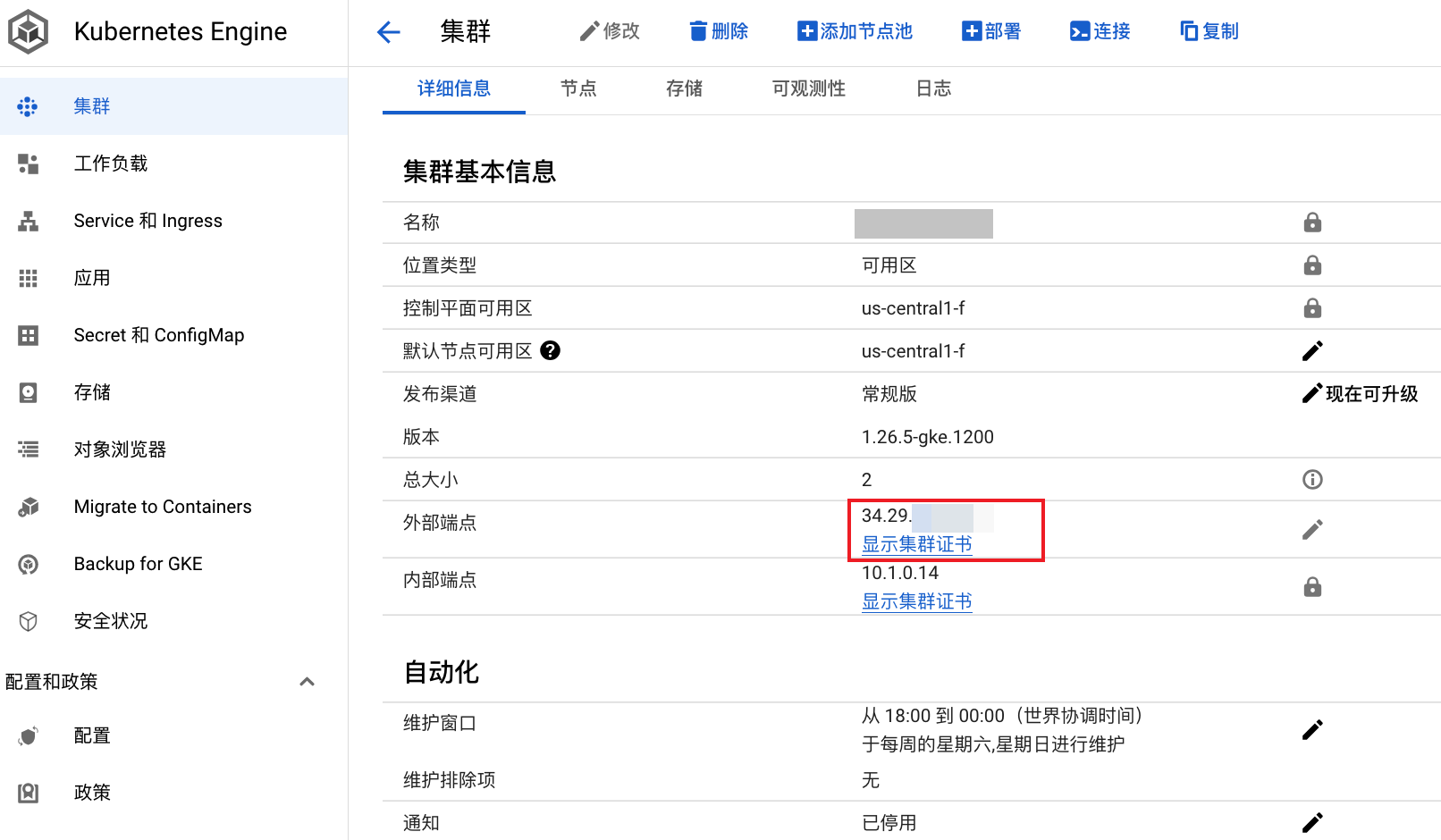
The access to the cluster’s apiserver address and CA certificate can be found in the External Endpoints section, as shown in the following figure:
Get Access Cluster Token
The KubeConfig file of a public cloud cluster cannot be directly used to access the cluster.
Please refer to the FAQ How to fetch the kubeconfig file? to obtain the access token for accessing the cluster.
Cluster of access
-
In the left navigation pane, click Clusters > Cluster of clusters.
-
Click on Cluster of access.
-
Configure the relevant parameters according to the following instructions.
Parameter Description repository The repository that stores the platform components images required by the cluster.
- Default: The repository configured when deploying global.
- Private repository: A pre-built repository that stores the platform components. You need to enter the private repository address, port, username, and password to access the repository.
- Public repository: Use a repository service located on the public network. Before using it, you need to refer to Updating public network repository cloud credentials to obtain repository authentication permissions.Cluster Information Cluster Information: Includes the cluster access token, the API server address of the cluster, and the CA certificate.
Cluster Address: The access address of the API server exposed by the cluster, used for platform access to the cluster’s API server.
CA Certificate: The CA certificate of the cluster.
Note: When manually entering, you need to enter the decoded certificate in Base64 format.
Authentication Method: The authentication method for accessing the cluster, which requires using the token (Token) with cluster management permissions created in the previous step for authentication. -
Click on Check Connectivity to verify the network connectivity with the connected cluster and automatically identify the type of the connected cluster. The cluster type will be displayed as a badge in the top right corner of the form.
-
After passing the connectivity check, click on Connect and confirm.
Tip:
-
Click on the
 icon on the right side of the cluster in the In Progress state to view the cluster’s execution progress (status.conditions) in the popped-up Execution Progress dialog box.
 -
After successful cluster access, you can view key information about the cluster in the cluster list. The status of the cluster is displayed as normal, and you can perform cluster-related operations.
-
Network Configuration
To ensure global connectivity with the accessed cluster network, please refer to the configuration related to accessing the cluster network .
What’s next
Deployment plugins
After successfully accessing the cluster, you can go to Plugin Management to select the necessary plugins for cluster deployment.
Namespace under the tube cluster
After accessing the cluster, you can add the cluster to an existing project by creating a project based on the cluster or by adding a cluster associated with the project , thus associating the newly accessed cluster with the project.
Furthermore, by performing the import namespace operation, existing Kubernetes namespaces within the cluster can be included and managed under the platform’s project.
FAQ
The Add node button is grayened after accessing the cluster. How to add nodes?
Cannot add nodes in the platform interface, please contact the cluster provider to add nodes.
Which certificates are supported by the certificate management function of the access cluster?
-
Kubernetes certificate: All access to the cluster only supports viewing the APIServer certificate information in the platform’s certificate management interface. It does not support viewing other Kubernetes certificates and does not support automatic rotation.
-
Platform Component Certificate: All access to the cluster can view the platform component certificate information in the platform certificate management interface and support automatic rotation.